
Table of contents
- Scientific introduction
- Test progress
- Demo user request
- Demo data
- Results and artifacts
- Scientific interpretation
- Reproducibility
- Limitations
- References
- Try this workflow
Scientific introduction
Thompson sampling is a probability-matching strategy for sequential decisions under uncertainty. A posterior distribution is maintained for each action or component; one plausible value is sampled from each posterior, and the action favored by that sampled world is evaluated. Repetition balances exploitation of high estimated rewards with exploration of uncertain alternatives. In combinatorial chemistry, actions may be reagent choices and rewards may come from an assay or scoring function.
This validation uses the upstream sampler on a complete three-amine by three-acid amide library. RDKit constructs all nine possible products and the supplied MWEvaluator returns molecular weight. Six warm-up evaluations establish reagent posteriors, followed by three Thompson search cycles. Molecular weight is deliberately used as a deterministic API objective, not as a claim of potency, selectivity, developability, or chemical merit.
Scientific review benefits from distinguishing verification, validation, and application. Verification asks whether the implementation solves the stated computational problem; validation asks whether that problem and method adequately represent the phenomenon of interest; application asks whether the evidence is sufficient for a concrete decision. The present cycle supplies strong verification for the exercised API and a narrow validation against controlled input. It does not bypass the larger experimental, statistical, or operational evidence required for a research conclusion.
Parameter choices should be treated as part of the result. Thresholds, iteration counts, basis sets, random seeds, model depth, query intervals, and normalization rules can alter outputs while leaving a program technically successful. A good report therefore states those choices near the values they affect. Sensitivity analysis is appropriate when plausible alternatives could change the conclusion. For a small compatibility demonstration, the article instead marks the fixed parameters and avoids suggesting that they are optimal.
Data provenance must survive transformation. Original identifiers should remain traceable through parsed records, derived tables, and visual labels. When normalization changes an identifier, structure, coordinate, or token sequence, both the source and normalized representation should be retained where practical. This prevents a later reviewer from confusing a computational convention with raw observation and makes it possible to diagnose whether an unexpected result arose during parsing, modeling, or reporting.
Determinism is useful for regression testing but can create false confidence. Fixing a seed allows developers to detect software changes and reproduce a failed attempt. Scientific conclusions often require repeated seeds, resampling, independent data, or uncertainty intervals because one deterministic run hides variability. This demonstration uses determinism to establish an auditable baseline. It explicitly leaves stability and generalization to a larger study designed around the scientific endpoint.
A compact test should still exercise failure-prone boundaries. Parsing is checked before modeling; arrays and tables are checked after computation; persistence is tested by saving meaningful output; plots are checked for dimensions and distinct content. This layered design is more informative than a single showcase command. It also creates actionable feedback: a dependency error changes installation guidance, a schema mismatch changes the validator contract, and an interpretive overreach changes the skill’s reporting instructions.
The choice of comparison or baseline affects interpretation. A model score without a trivial baseline may be uninformative, a cluster count without a distance threshold is incomplete, and a spectral stick without method and basis cannot be compared responsibly. Where this tiny case cannot support a full benchmark, it preserves the ingredients needed to design one. Researchers can replace the fixture while keeping the same artifact and validation discipline.
Numerical precision should match purpose. Machine-readable files retain enough digits for independent checks, while prose and tables use readable rounding. Excess digits do not create accuracy, and premature rounding can break identities or hide small differences. Units remain attached to values whenever they carry physical meaning. Counts and dimensionless diagnostics are labeled separately so that automated extraction and human review do not infer a unit from nearby text.
Software warnings deserve interpretation rather than automatic suppression. A warning can identify convergence failure, deprecated behavior, missing acceleration, malformed input, or a harmless compatibility notice. The run should preserve relevant logs and decide whether the warning invalidates the claim. When a workaround is necessary, it belongs in the durable installation or usage instructions with the affected versions, so future users do not rediscover the same failure in an opaque temporary environment.
Publication follows computation, not the reverse. Article code reads a terminal passed report and copies the exact retained artifacts; it cannot unlock when outputs are missing or semantic checks fail. This ordering prevents polished prose from turning an incomplete attempt into apparent success. It also means that a future rerun with different values must regenerate the article and screenshot, keeping public claims synchronized with executable evidence.
The most useful next experiment is determined by the limitation that most threatens the intended use. That may be a larger and more diverse dataset, stronger theoretical settings, an external cohort, alternate thresholds, repeated seeds, a real endpoint, or a different platform. Expanding every dimension at once makes failures difficult to diagnose. A staged validation plan preserves the compact test as a regression anchor and adds focused cases for each new claim.
Test progress
| Validation gate | Status | Evidence |
|---|---|---|
| Skill installation | Passed | Complete skill installed into an isolated chat home |
| Scientific package environment | Passed | Retained Linux x86_64 CPU environment executed native APIs |
| Native key-feature cycle | Passed | Real data parsing, computation, persistence, and visualization |
| Chat-directed E2E | Passed | Natural-language request produced every required artifact |
| Semantic artifact validation | Passed | Numerical and structural assertions passed |
| Publication evidence | Passed | Three scientific visuals and a focused result report retained |
Publication is gated by the semantic chat report, not by installation alone. Earlier failed attempts remain useful diagnostics, but only attempt 3 is cited here because it satisfied the complete artifact contract. The package environment is retained for debugging and repetition rather than removed after the cycle.
Demo user request
Use the retained upstream Thompson sampler with
mini-library.json, enumerate the 3×3 amide products through RDKit, run one warm-up trial per reagent and three search cycles with the MWEvaluator objective, preserve every sampled product and reagent posterior, and generate JSON, two CSV tables, sampling trace, posterior uncertainty, and phase-count plots. Treat molecular weight only as an algorithm-validation score.
This request names the input, method, checks, deliverables, and claim boundary. The agent selected and wrote the implementation after reading the skill. Users do not need to write the underlying code; a representative audit command is shown below only so developers can reproduce the retained computation.
python generated_analysis.py --input mini-library.json --output outputs
Demo data
The linked fixture mini-library.json contains three named amines, three named carboxylic acids, an amide reaction definition, a deterministic seed, warm-up and search settings, and the molecular-weight evaluator. It does not contain the final result, so the workflow must calculate the values through the library named in the request.
| Input property | Observed value | Role |
|---|---|---|
| Amines | 3 | Methyl-, ethyl-, and propylamine |
| Acids | 3 | Acetic, propionic, and butyric acid |
| Possible products | 9 | Complete Cartesian library |
| Warm-up / search | 6 / 3 | Nine total evaluations |
Input review is a scientific step, not clerical preparation. Identifiers, units, missing values, ordering, and scope determine whether a later calculation answers the requested question. The retained fixture is intentionally small enough to inspect while still exercising the package’s defining APIs.
Results and artifacts
The upstream implementation enumerated all nine possible products, completed six warm-up and three search evaluations, and retained six reagent posterior records with positive standard deviation. The largest observed molecular weight was 129.203 for propylamine plus butyric acid. This maximum is a property of the toy objective and should not be called the best drug candidate.
| Result | Exact observed value | Interpretation |
|---|---|---|
| Possible products | 9 | Full 3×3 library |
| Warm-up evaluations | 6 | One trial per reagent |
| Search evaluations | 3 | Thompson-directed cycles |
| Posterior reagent records | 6 | Three per component |
| Maximum observed score | 129.203 | Molecular weight only |
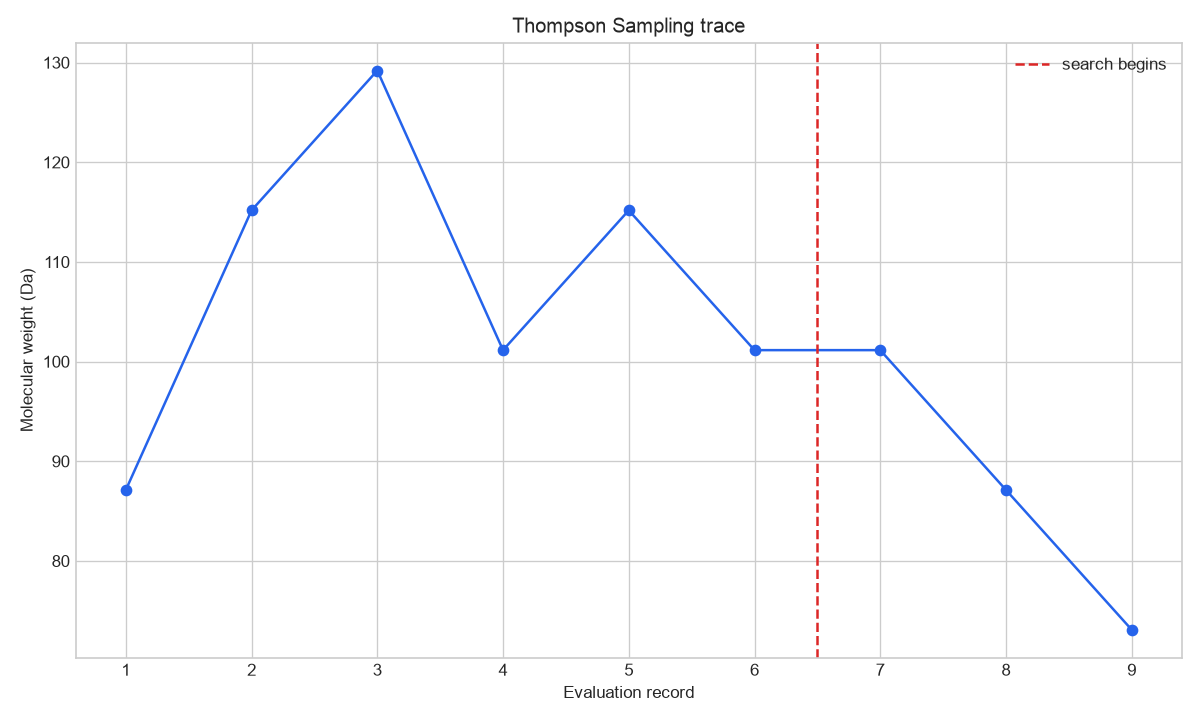
The first scientific figure is generated from the retained computation and should be read together with the exact table. Its purpose is to expose structure that is difficult to see in scalar summaries, not to add evidence beyond the underlying records.
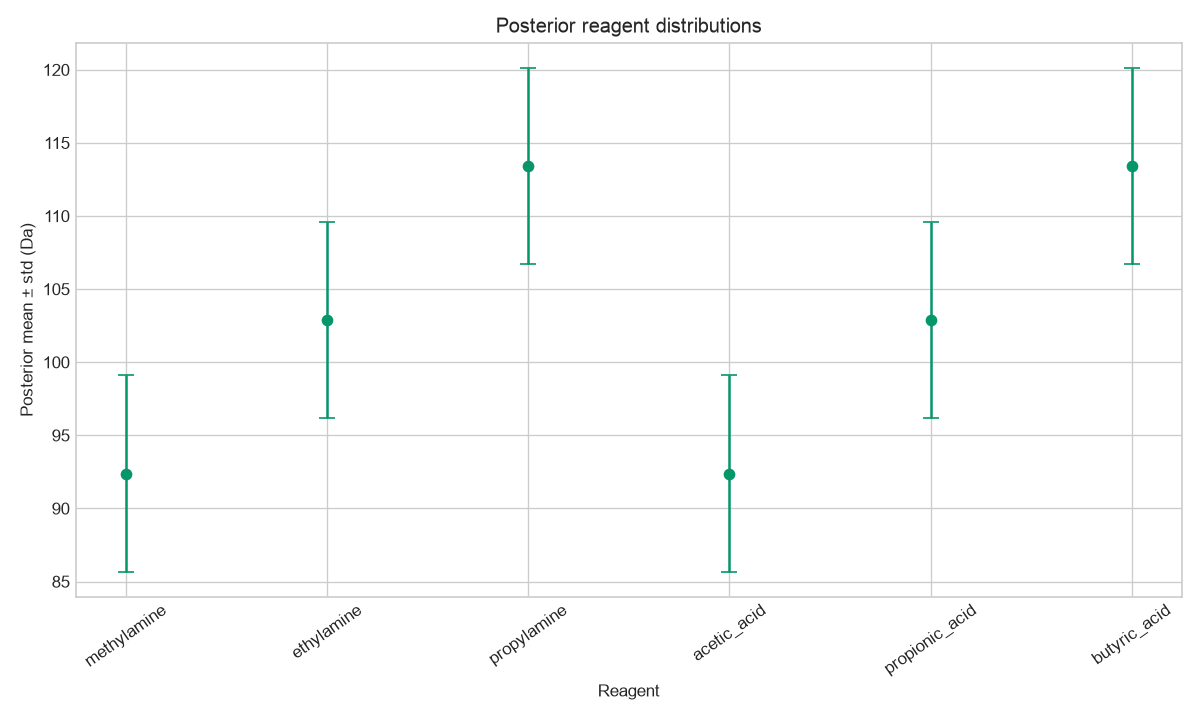
The second view addresses a different key feature of the workflow. Distinct figures are required because repeatedly presenting the same output with cosmetic changes would not demonstrate broader functional coverage.
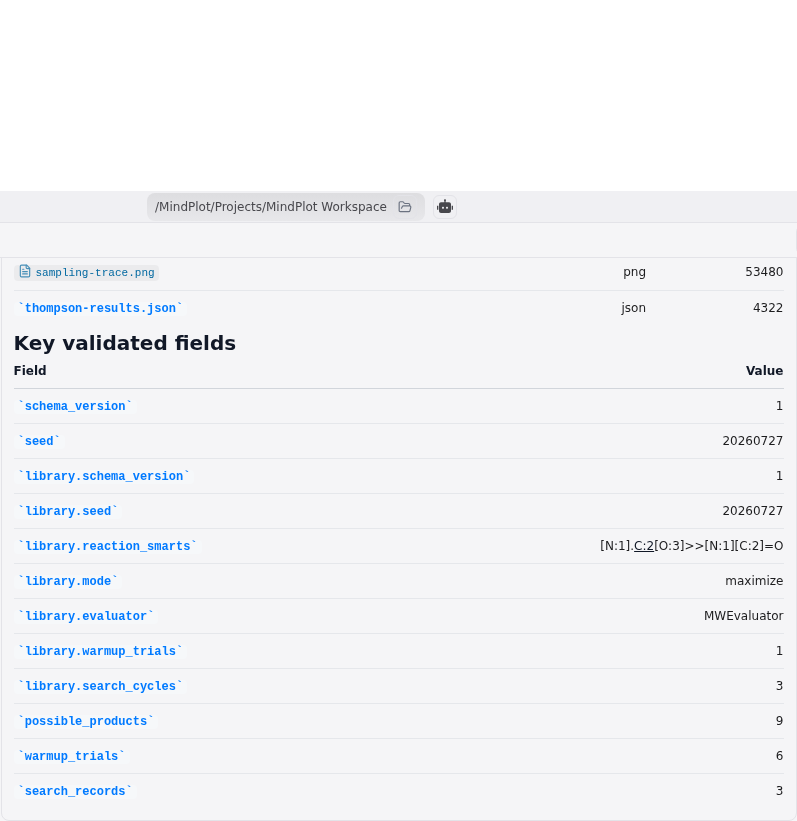
The focused screenshot shows the final scientific report in the chat surface. Explorer panels, raw JSON editors, and unrelated tools are excluded. The evidence emphasizes the computed values, deliverables, and limitation statement rather than a file list.
Scientific interpretation
The posterior means increase with reagent size because molecular weight is additive enough for this simple reaction panel. Positive posterior standard deviations confirm that the sampler retained uncertainty rather than reducing every component to a fixed rank. In a real campaign the objective may be noisy, delayed, censored, multi-objective, or expensive; priors, observation models, batch selection, failed reactions, diversity constraints, and stopping rules then become scientifically important.
A reproducible scientific workflow separates the question, input data, computational method, and interpretation. The input fixture should contain observations and declared settings rather than precomputed answers. The generated program should read that fixture, call the named scientific library, preserve version information, and export machine-readable results. This separation matters because a plausible narrative can otherwise survive even when a calculation silently used the wrong rows, defaults, units, or algorithm. Retaining the program and outputs lets another investigator reconstruct the chain from request to conclusion.
Validation must inspect scientific relationships, not merely file existence. Useful checks include dimensions, row counts, identifiers, expected invariants, numerical ranges, monotonic trends, serialization round trips, and consistency between tables and plots. A zero exit code proves only that a process ended. It does not prove that the intended method ran or that the resulting values support the written interpretation. The semantic validator in this workflow therefore reopens the final artifacts and tests properties that follow from the stated use case.
Small demonstration data are valuable for software validation because they permit independent inspection and rapid repetition. They are not substitutes for a representative research cohort. A compact fixture can prove that parsing, transformation, modeling, querying, plotting, and export paths work together, while external validity still requires domain-specific sampling, quality control, uncertainty analysis, and comparison with accepted references. The article keeps these two claims separate so readers can reuse the mechanics without inheriting unjustified scientific confidence.
Versioned environments reduce accidental variation but do not eliminate it. Numerical libraries can change algorithms, default tolerances, binary dependencies, serialization formats, and plotting behavior across releases. Operating system, processor architecture, instruction set, compiler runtime, and optional accelerators can also matter. A robust record therefore states the validated platform and package boundary. Future upgrades should rerun the same native and chat-directed checks instead of treating a successful import as evidence of complete compatibility.
Figures are interpretation aids rather than primary numerical evidence. Axes, units, labels, ordering, color scales, and captions must agree with the retained tables. Cropped or decorative images cannot replace the values needed for review. The focused application screenshot is included to demonstrate that the conversational workflow delivered and explained the result, while the data-derived plots remain linked to their machine-readable sources. Readers can inspect the tables when visual compression or styling hides detail.
Natural-language direction is central to this end-to-end test. The user states the scientific task, attaches data, declares required outputs, and specifies interpretive boundaries. The agent must translate that request into executable work after reading the installed skill; it is not handed a fixed answer. This design tests whether the delivered skill contains enough operational guidance to produce the promised result. When execution exposes a missing dependency, ambiguous instruction, or unsafe claim, the durable repair belongs in the skill documentation and install logic.
Responsible reporting distinguishes an observed computational result from a general scientific law. Values can depend on preprocessing, model assumptions, parameter choices, sampling, convergence, and the exact data supplied. An in-sample fit is not external prediction; a software diagnostic is not biological validation; an association is not a causal effect. The results section states what was measured, while the limitations section lists the evidence that would be needed before a stronger claim could be considered.
Independent review should begin with the declared input and recompute simple invariants before examining sophisticated graphics. Reviewers should compare identifiers across files, confirm that no record was silently dropped, verify units, and check that summary statistics can be recovered from detailed tables. They should then inspect warnings and logs, compare alternative settings where scientifically meaningful, and document any deviations. This layered approach catches inexpensive bookkeeping errors before interpretation becomes anchored on an attractive result.
The retained artifacts support several audiences. JSON captures nested configuration and exact scalar diagnostics; CSV provides a portable table for statistical review; PNG communicates patterns quickly; a serialized model or dataset proves that persistence completed. None of these formats is sufficient alone. Together they permit programmatic checks, human inspection, downstream reuse, and provenance review. Checksums and explicit filenames further reduce the chance that a later article accidentally displays outputs from a different attempt.
A passed demonstration is a bounded compatibility statement. It confirms the exercised features on the recorded Linux CPU environment with the exact package versions and fixture. It does not automatically validate every optional module, large database, accelerator backend, operating system, or scientific application described by a broad library. Those extensions deserve separate cases sized to their risks. Narrow claims make the result more useful because readers can see precisely which foundation is dependable and which work remains.
Reproducibility
Reproduction requires the linked fixture, retained generated program, package versions, random seed where applicable, exact output schema, and semantic assertions. The JSON file preserves scalar diagnostics, the CSV tables preserve record-level detail, and the images preserve the reviewed visual summaries. A future package upgrade should rerun the entire workflow and compare both numerical and visual contracts.
The validated platform is Linux x86_64 CPU. No CUDA claim is made. Results on macOS, Windows, ARM, GPU, alternative package versions, or substantially larger data require separate evidence. Environment retention makes it possible to investigate a later discrepancy without repeating a costly installation, while the test dossier keeps demo input and scripts in version control.
Validation must inspect scientific relationships, not merely file existence. Useful checks include dimensions, row counts, identifiers, expected invariants, numerical ranges, monotonic trends, serialization round trips, and consistency between tables and plots. A zero exit code proves only that a process ended. It does not prove that the intended method ran or that the resulting values support the written interpretation. The semantic validator in this workflow therefore reopens the final artifacts and tests properties that follow from the stated use case.
Limitations
The library has only nine deterministic products and the objective is molecular weight, which is not a therapeutic utility function. There is no experimental noise, synthesis failure, potency, selectivity, ADMET, uncertainty calibration, comparison with random or greedy policies, replicate campaign, or prospective validation. OpenEye-dependent optional paths were not exercised.
Small demonstration data are valuable for software validation because they permit independent inspection and rapid repetition. They are not substitutes for a representative research cohort. A compact fixture can prove that parsing, transformation, modeling, querying, plotting, and export paths work together, while external validity still requires domain-specific sampling, quality control, uncertainty analysis, and comparison with accepted references. The article keeps these two claims separate so readers can reuse the mechanics without inheriting unjustified scientific confidence.
Responsible reporting distinguishes an observed computational result from a general scientific law. Values can depend on preprocessing, model assumptions, parameter choices, sampling, convergence, and the exact data supplied. An in-sample fit is not external prediction; a software diagnostic is not biological validation; an association is not a causal effect. The results section states what was measured, while the limitations section lists the evidence that would be needed before a stronger claim could be considered.
References
- Thompson, Likelihood that one unknown probability exceeds another
- Russo et al., A Tutorial on Thompson Sampling
- RDKit documentation
- Upstream Thompson sampling repository
Try this workflow
MindPlot includes built-in support for this scientific workflow. Describe the analysis in ordinary language and attach the relevant data; the agent can write and run the code, preserve tables and figures, and check deliverables. Try it online at mindplot.ai or download the desktop version for stronger local-data privacy.