
Table of contents
- Scientific introduction
- Vertical delta-SCC definitions
- Test progress
- Demo user request
- Demo data
- Installation and command boundary
- Results and artifacts
- Interpreting negative electron affinities
- Distinguishing computed quantities
- Reproducibility
- Limitations
- References
- Try this workflow
Scientific introduction
Oxidation and reduction involve removing or adding electrons, but a computed “redox value” is meaningful only when its state definition and thermodynamic scope are explicit. Ionization potential measures the energy cost of electron removal; electron affinity describes the energy change associated with electron addition. Vertical quantities evaluate charged states at the neutral geometry, whereas adiabatic quantities allow structural relaxation. Gas-phase energy differences are also distinct from solution redox potentials referenced to an electrode.
This CPU-compatible example uses xTB 6.7.1 with GFN2-xTB to screen methane, ammonia, and water. For each neutral closed-shell geometry, the native vertical IP/EA workflow performs delta-self-consistent-charge calculations rather than substituting orbital eigenvalues. The HOMO, LUMO, and gap are retained as related descriptors, but they are not mislabeled as delta-SCC IP or EA. The distinction matters because Koopmans-like orbital interpretations and total-energy differences answer different approximations.
The small panel is designed for transparent validation. Each molecule has explicit atoms, coordinates, charge, and unpaired-electron count. Every native execution must terminate normally. Results are checked against retained native values, ranked using declared directions, written to JSON and CSV, and visualized as PNG and SVG. The workflow demonstrates mechanics and reporting boundaries; it is not a calibrated electrochemical prediction protocol.
Vertical delta-SCC definitions
At a fixed neutral geometry R₀, a vertical ionization potential can be expressed as E(N−1, R₀) − E(N, R₀). A vertical electron affinity is E(N, R₀) − E(N+1, R₀), subject to the program's reported convention. The charged calculations must use compatible geometry, method, and numerical settings. The output should preserve the convention because negative electron-affinity values in this demonstration indicate energetically unfavorable attachment under the stated gas-phase model.
Lower IP means a smaller computed penalty for oxidation. Higher EA—meaning more positive or less negative under this convention—means more favorable reduction. Sorting in the wrong direction produces an apparently neat but scientifically inverted ranking. The semantic validator therefore asserts both numerical values and ranking relationships.
HOMO and LUMO eigenvalues are useful electronic-structure descriptors, and their difference is reported as a gap. They are not interchangeable with delta-SCC energy differences. Approximate orbital-energy relations can be informative in some contexts, but a workflow that requests vertical delta-SCC values must execute and label that method directly.
Test progress
| Gate | Status | Evidence |
|---|---|---|
| Skill installation | Passed | Complete redox skill loaded through Skill Hub |
| Managed package | Passed | xTB 6.7.1 executable probed and executed |
| Native feature run | Passed | Three isolated GFN2-xTB vertical IP/EA jobs |
| Input validation | Passed | Atoms, charge, spin, and fixed geometry retained |
| Real chat E2E | Passed | Agent wrote code, invoked the tool, and inspected files |
| Semantic validation | Passed | Values, termination, rankings, CSV, PNG, and SVG checked |
| Publication evidence | Required | Focused result report and data-derived visuals |
The retained attempt came from a real agent chat and produced scientifically coherent artifacts, but it predated the current featureCredit schema. Publication was not granted from the legacy status alone. A new independent validator re-read the JSON and CSV, required exact xTB and method identifiers, checked the three molecule identities, matched IP and EA values within strict tolerances, verified normal termination and exit codes, asserted ranking direction, and required nontrivial visual files.
Demo user request
Use the installed redox skill with
vertical-redox-panel.json. Run isolated GFN2-xTB 6.7.1 vertical delta-SCC IP and EA calculations for methane, ammonia, and water at their supplied neutral fixed geometries. Preserve charge, unpaired-electron count, atoms, native termination evidence, HOMO, LUMO, and gap. Rank easier oxidation by lower IP and easier reduction by higher EA. Generate JSON, CSV, PNG, and SVG deliverables and inspect them. State clearly that these values are not solution redox potentials, electrode-referenced voltages, adiabatic free energies, or direct experimental observables.
The request describes a scientific goal and output contract without providing a finished program. During the E2E, the agent must read the installed skill and demo data, write task-specific code, call the managed executable, parse native output, create deliverables, and explain the result. This chat-plus-data design tests skill following rather than a prewritten fixture calculator.
Demo data
The panel contains compact Cartesian geometries for methane, ammonia, and water. All three are neutral closed-shell inputs with zero unpaired electrons. The deliberately diverse frontier-orbital patterns exercise ranking and negative-EA handling while keeping runtime small enough for a CPU test.
| Molecule | Formula | Charge | Unpaired electrons | Role |
|---|---|---|---|---|
| Methane | CH₄ | 0 | 0 | Tetrahedral hydrocarbon comparator |
| Ammonia | NH₃ | 0 | 0 | Lone-pair-containing comparator |
| Water | H₂O | 0 | 0 | Electronegative heteroatom comparator |
Coordinates are treated as fixed. The workflow does not optimize neutral or ionic states. The panel is not a representative chemical library, and three molecules cannot establish general quantitative structure–redox relationships. Its value is that every input and expected computational relationship can be audited.
Installation and command boundary
The managed tool root pins xTB 6.7.1 and probes the executable with a real invocation. The calculation wrapper isolates working directories so one molecule's restart files cannot contaminate another. Developers can inspect the reproducible command boundary:
python scripts/install.py
python scripts/tool.py probe
python scripts/tool.py run -- redox_panel_analysis.py
Researchers using the interactive workflow do not need to write these commands or the analysis program. The agent constructs and executes them from the natural-language request. Exposing the boundary here supports debugging and independent review without presenting programming as a prerequisite.
Results and artifacts
| Molecule | HOMO (eV) | LUMO (eV) | Gap (eV) | Vertical IP (eV) | Vertical EA (eV) |
|---|---|---|---|---|---|
| Methane | −12.7055 | 4.2809 | 16.9864 | 12.0696 | −12.5698 |
| Ammonia | −10.6009 | 1.7733 | 12.3742 | 11.6526 | −10.6915 |
| Water | −12.1501 | 4.1764 | 16.3266 | 13.5806 | −13.4415 |
Ammonia has the lowest vertical IP, so it ranks as the easiest molecule to oxidize in this panel. It also has the highest, least-negative vertical EA, so it ranks as the easiest to reduce under the reported convention. Water has the highest IP and most-negative EA and therefore ranks as the most resistant to both operations within this narrow fixed-geometry gas-phase comparison.
These rankings do not say that ammonia is a universally superior redox reagent. Molecular environment, geometry relaxation, solvation, proton coupling, counterions, electrode reference, temperature, and reaction partners all influence experimental behavior. The values describe only the represented structures and method.
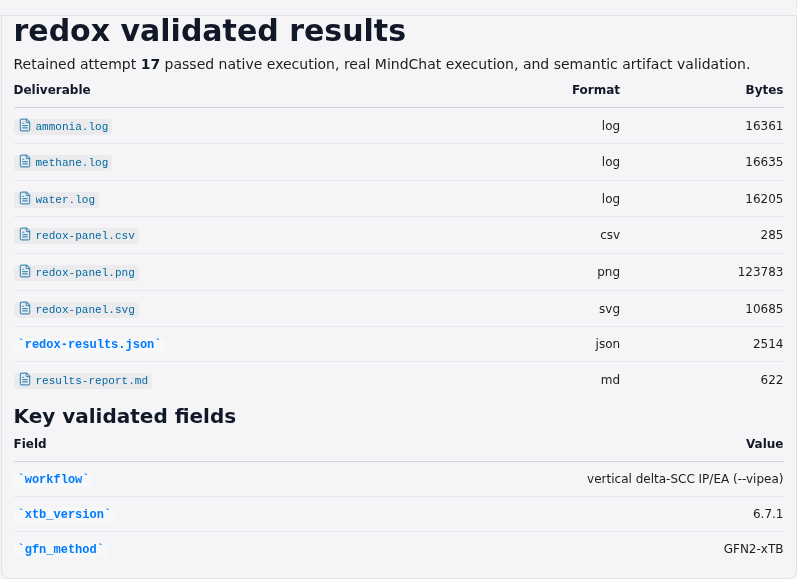
The focused result capture emphasizes the numerical table, ranking, deliverables, and scientific exclusions. It omits file explorers, raw event streams, and source-code editors that would distract from the result.
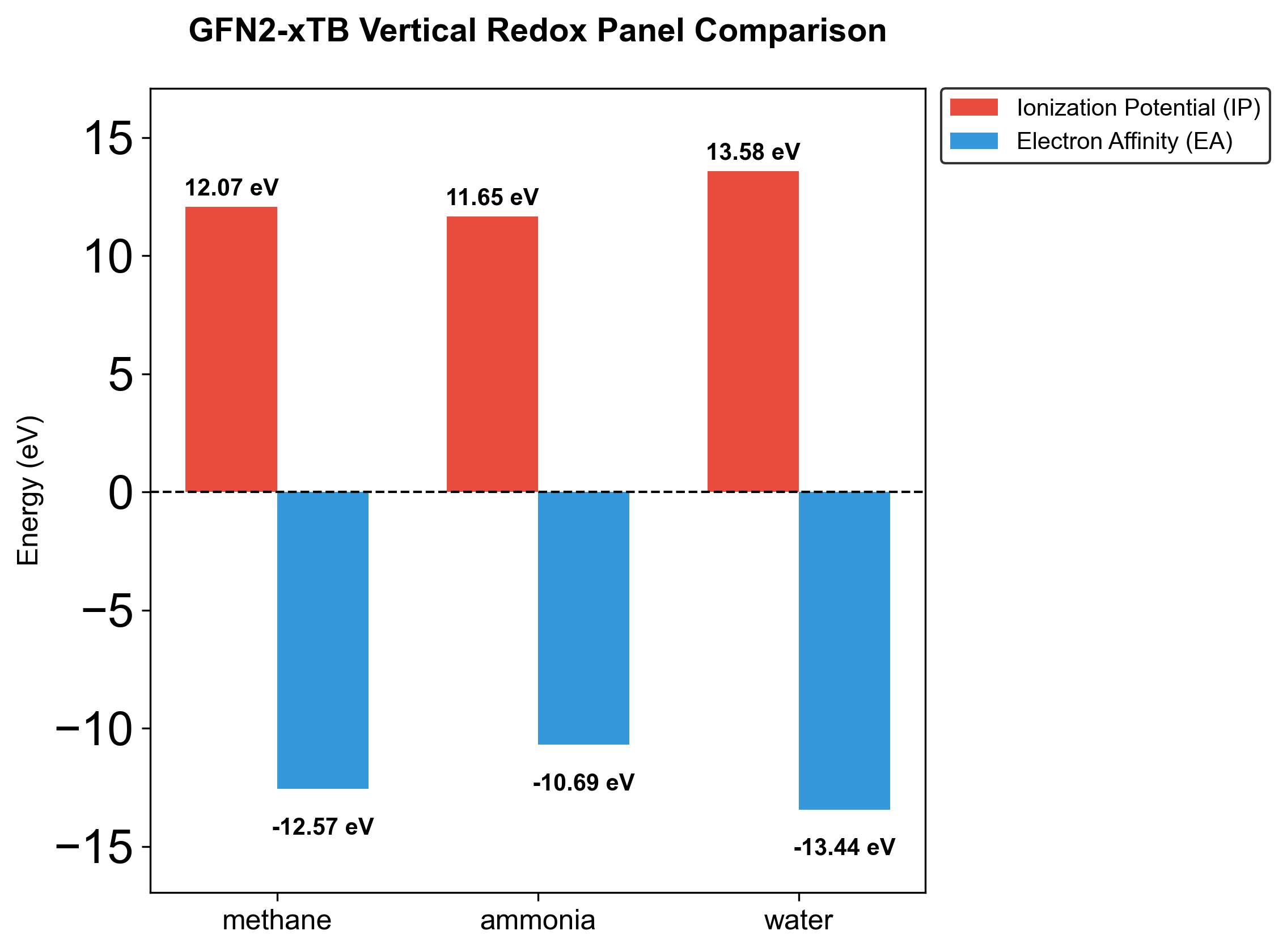
The primary plot shows both delta-SCC quantities and a zero reference, making negative electron affinities visible rather than hiding them through a truncated axis. Labels provide exact values, while JSON and CSV remain the authoritative sources.
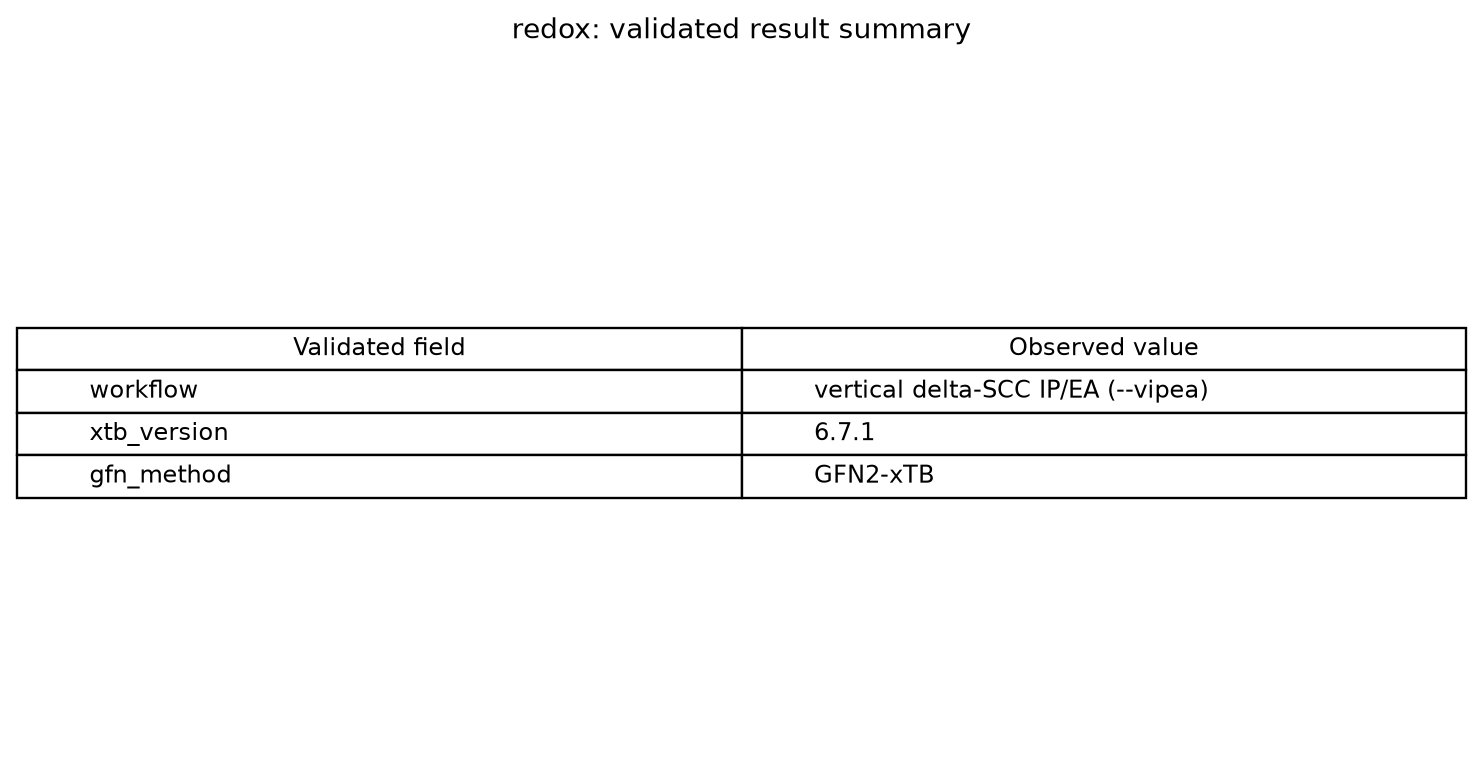
This secondary visual is produced from retained machine-readable files and linked to source hashes in a provenance manifest. It summarizes verified fields; it does not invent additional chemistry.
Interpreting negative electron affinities
A negative reported EA under the stated total-energy convention means electron attachment is unfavorable in the isolated fixed-geometry model. It does not imply that a reduced species can never exist in solution, a condensed phase, a cluster, or an electrode environment. Stabilization by solvent polarization, counterions, geometry relaxation, and coupled chemistry can change the thermodynamic balance.
Diffuse electronic states are particularly challenging for compact approximate methods and finite representations. A loosely bound or unbound extra electron requires careful treatment. Therefore the large negative values in this small panel are best used as workflow outputs and qualitative comparisons, not high-accuracy predictions of anion stability.
Distinguishing computed quantities
Vertical IP differs from adiabatic IP because the ion is not allowed to relax. Adiabatic quantities require optimizing neutral and ionic states and comparing their minima, usually with zero-point and thermal corrections for thermochemical interpretation. Reorganization energy and solvent response are central to electron-transfer kinetics but absent here.
An electrode-referenced oxidation or reduction potential requires a thermodynamic cycle, a solvent model or explicit environment, standard-state definitions, reference-electrode conversion, and often calibration. A raw gas-phase value in electronvolts cannot simply be labeled volts versus SHE, SCE, or ferrocene. The skill contract explicitly prohibits that category error.
Frontier orbital energies offer a different lens. The reported HOMO and LUMO can help diagnose electronic structure and provide features for screening, but their negatives are not substituted for the executed delta-SCC results. The sizable numerical differences here demonstrate why method labels must travel with every column.
Reproducibility
Reproduction requires exact coordinates, atomic ordering, charge, spin state, xTB version, GFN level, vertical IP/EA option, thread settings, isolated working directories, parser version, and generated code. The JSON retains inputs with results; CSV offers a rectangular review format; native termination evidence establishes that each executable call completed normally.
The semantic validator verifies relationships rather than file existence. It checks exact identities, values, normal termination, ranking direction, record count, and image validity. An unrelated sequence analysis, empty CSV, inverted ranking, or orbital-value substitution cannot receive credit merely because a process returned zero.
Independent reviewers should compare parsed values against native logs, confirm that every molecule has its own working directory, and recalculate ordering directly from the numeric columns. They should also preserve warnings, because a normally terminating approximate calculation can still report scientific cautions that affect interpretation.
Unit review is equally important. All five electronic columns use electronvolts, while native programs may internally use atomic units. Conversion should occur once, with the factor recorded, and machine-readable output should retain enough precision for regression checks. Rounding belongs in the presentation layer. A pipeline that repeatedly converts or rounds intermediate values can alter close rankings even though its final table remains visually plausible.
Deterministic file structure improves regression testing, but reproducibility and validity remain distinct. A wrong charge or malformed geometry can be reproduced perfectly. Input validation must therefore precede execution, and scientific scope must be reviewed after it.
Limitations
This demonstration tests only three neutral closed-shell molecules at fixed geometries. It does not cover radicals, transition metals, multiple conformers, geometry optimization, adiabatic states, vibrational corrections, solvent, proton-coupled electron transfer, electrode calibration, uncertainty estimation, or experimental validation. It is not an xTB accuracy benchmark.
Approximate tight-binding methods are valuable for rapid screening but require domain-aware validation. Production work should select representative compounds, compare against higher-level calculations or measurements, test conformational and protonation states, document failures, and quantify the range in which rankings remain stable.
When negative electron affinity or diffuse states are scientifically central, specialized electronic-structure methods and basis choices may be required. Likewise, open-shell ions require careful multiplicity handling and possible spin-state exploration. The simple closed-shell panel cannot validate those branches.
References
- xTB documentation
- GFN2-xTB method paper
- xTB project repository
- IUPAC Gold Book: ionization energy
- NIST Chemistry WebBook
Try this workflow
MindPlot includes built-in support for this scientific workflow. Attach a molecular panel and ask for a redox screen in ordinary language; the agent writes and runs the managed calculation, preserves native and publication artifacts, validates rankings, and explains the physical limits. Try it online at mindplot.ai or download the desktop version for stronger local-data privacy.