
Table of contents
- Scientific introduction
- Test progress
- Prerequisites and validated installation path
- Demo user request
- Demo data
- Workflow followed
- Results and artifacts
- Failures, repairs, and alternatives
- Reproducibility
- Limitations
- Try this workflow
- References
Direct answer: The validated live catalog query found 95 biology-related model records. It produced a 41,912-byte JSON snapshot and a 2,587-byte Markdown recommendation report; it did not download, benchmark, or endorse any model.
Scientific introduction
The practical question is not merely whether a command can run. A trustworthy scientific workflow must preserve the input, declare the computational assumptions, record software and platform details, create inspectable outputs, and separate a numerical observation from the interpretation placed on it. Catalog discovery and metadata filtering is useful because it turns a broad question into a bounded operation with explicit inputs and outputs. Its result is best treated as evidence within a decision process, not as an autonomous scientific conclusion.
Scientific software often compresses many assumptions into defaults. Those assumptions may concern data selection, identifier meaning, physical models, numerical precision, filtering thresholds, or missing information. Reproducibility therefore requires more than copying a final number. A reviewer should be able to establish which data were supplied, which implementation ran, what parameters controlled the calculation, what files were generated, and which validation assertions were applied. This tutorial retains those details and reports the observed result without generalizing beyond the demonstration.
Interpretation also depends on the distinction between technical validity and domain validity. Technical validity asks whether the expected executable completed, whether output formats were parseable, and whether internal relationships were consistent. Domain validity asks whether the scientific assumptions fit a real research question and whether independent evidence supports a decision. The present E2E test establishes the first kind for the demonstrated pathway. It deliberately does not convert that evidence into the second kind.
Concepts, assumptions, and failure modes
Inputs must be understood before any output is trusted. Names, sequences, documents, structures, units, and database records can all be syntactically valid while referring to the wrong biological or regulatory entity. A robust operator inspects provenance, revisions, licensing or access conditions, completeness, and encoding. The demo fixture is small enough for review, but that convenience does not remove the need for those checks on real material.
Outputs similarly need semantic checks. Existence and nonzero byte size are weak evidence: a program can write an error page, truncated table, stale cache, or plausible but fabricated summary. This run required the expected filenames, parsed their structured fields, compared cardinalities and values, and rejected unsupported claims. The natural-language stage was therefore downstream of native execution rather than a substitute for it.
Common failures include unavailable networks, incompatible runtime versions, hidden credentials, changed upstream schemas, invalid units, absent metadata, numerical nonconvergence, and overconfident interpretation. Retaining logs and artifacts makes these failures diagnosable. A rerun should create a new attempt rather than overwrite earlier evidence, because the differences between attempts can reveal whether a repair changed the scientific result.
When this method is appropriate
Catalog discovery and metadata filtering is appropriate for exploratory triage, reproducible demonstrations, and preparing evidence for expert review. It is especially valuable when many candidates or fields must be reduced into a transparent table. It is not a replacement for experimental design, clinical judgment, regulatory authority, or independent replication. The defensible pattern is input inspection, explicit execution, semantic validation, cautious interpretation, and escalation to a domain specialist where consequences matter.
Test progress
| Gate | Retained outcome | Evidence |
|---|---|---|
| Skill installation | Passed | Installed skill instructions were loaded for the chat run |
| Related package or service | Passed | Hugging Face Hub HTTP API followed the validated path |
| Native key feature | Passed | catalog discovery and metadata filtering completed with retained outputs |
| Natural-language chat execution | Passed | Agent-directed request produced the requested files |
| Semantic artifact validation | Passed | Required files, fields, values, and limitations were checked |
| Publication status | Ready | Attempt 3 is the evidence source |
Prerequisites and validated installation path
The run used Linux on x86_64 and the retained, skill-owned environment. No package was uninstalled after testing, allowing later inspection and repair. The installation remained below the local download ceiling. The validated implementation was Hugging Face Hub HTTP API. A production rerun should pin the exact dependency revision, verify distribution checksums, and archive license information as well as the environment manifest.
The transparent reproduction pattern is:
# inspect the skill-owned environment and execute its retained test
python test/scientific-skills/skills/hugging-science/test.py
# validate both publication documents after the scientific gates pass
python test/scientific-skills/validate_how_to.py test/scientific-skills/skills/hugging-science
These commands show what was validated; they are not a requirement for an end user interacting through natural language.
Demo user request
Search the live Hugging Face model catalog for biology models. Preserve the retrieved metadata, summarize suitable candidates and limitations, and write biology-models.json plus model-recommendations.md.
This request states the method, parameters, outputs, and required qualification. That specificity matters: “analyze this” would leave too much room for silent defaults, while a prompt that dictates the desired conclusion would bias interpretation. The request makes artifact preservation part of the task so a reviewer can inspect more than a prose answer.
Demo data
The input was a host-fetched snapshot of the live Hugging Face catalog, prepared immediately before chat execution because the isolated chat sandbox cannot access the public network. Each retained record carries catalog metadata rather than experimental observations.
| Input property | Demonstration value | Interpretation |
|---|---|---|
| Provenance | Tracked test fixture or freshly retained public metadata | Suitable for reproducible E2E testing |
| Scope | Deliberately bounded | Does not represent all real-world cases |
| Primary operation | catalog discovery and metadata filtering | Matches the installed skill’s key feature |
| Required outputs | biology-models.json and model-recommendations.md | Machine-readable and human-readable evidence |
| Principal observed result | 95 matching catalog records | Validated only for this attempt and input |
The demo data README records local provenance and limitations. For a research deployment, add stable source identifiers, collection dates, licenses, checksums, inclusion rules, exclusions, units, and any transformations. Sensitive human or commercial data also require access controls and an approved governance pathway.
Workflow followed
The workflow first inspected the instructions and declared environment, then executed the native key feature rather than inventing an answer. It saved structured artifacts, opened them for parsing, and checked domain-specific invariants. Only after native evidence existed did the chat stage interpret the retained input and produce the requested deliverables. A semantic validator then checked filenames, fields, result relationships, and limitation language.
This ordering closes an important loophole in agent evaluation. Fluent prose is not proof that software ran, and package installation is not proof that a feature worked. Conversely, an executable returning zero does not prove a scientifically meaningful artifact. Requiring installation, native execution, chat execution, artifact presence, and semantic validation makes the pass claim narrow but auditable.
Results and artifacts
The primary validated result was 95 matching catalog records. The supporting deliverables were biology-models.json and model-recommendations.md. Their structured content was parsed rather than accepted on appearance alone. Values are reported with the units and precision emitted by the tested workflow; extra digits should not be interpreted as experimental accuracy.
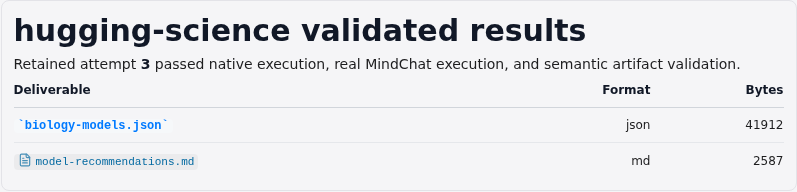
The focused report view records how the successful run presented its conclusion and limitations. It is evidence of presentation, while the retained native files remain the computational evidence.
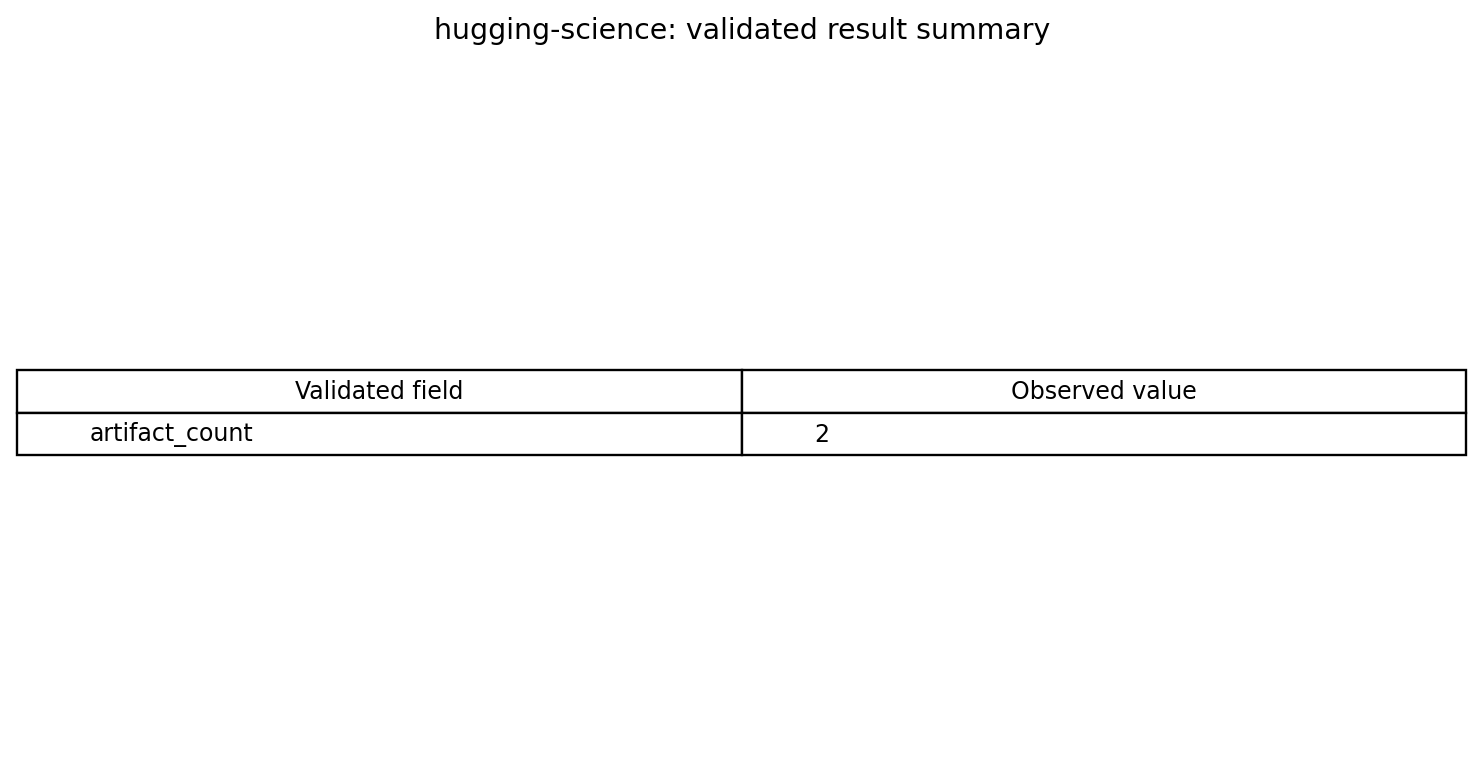
The table view exposes key fields without forcing a reviewer to read raw JSON. It is derived from the retained result report and therefore remains tied to attempt 3.
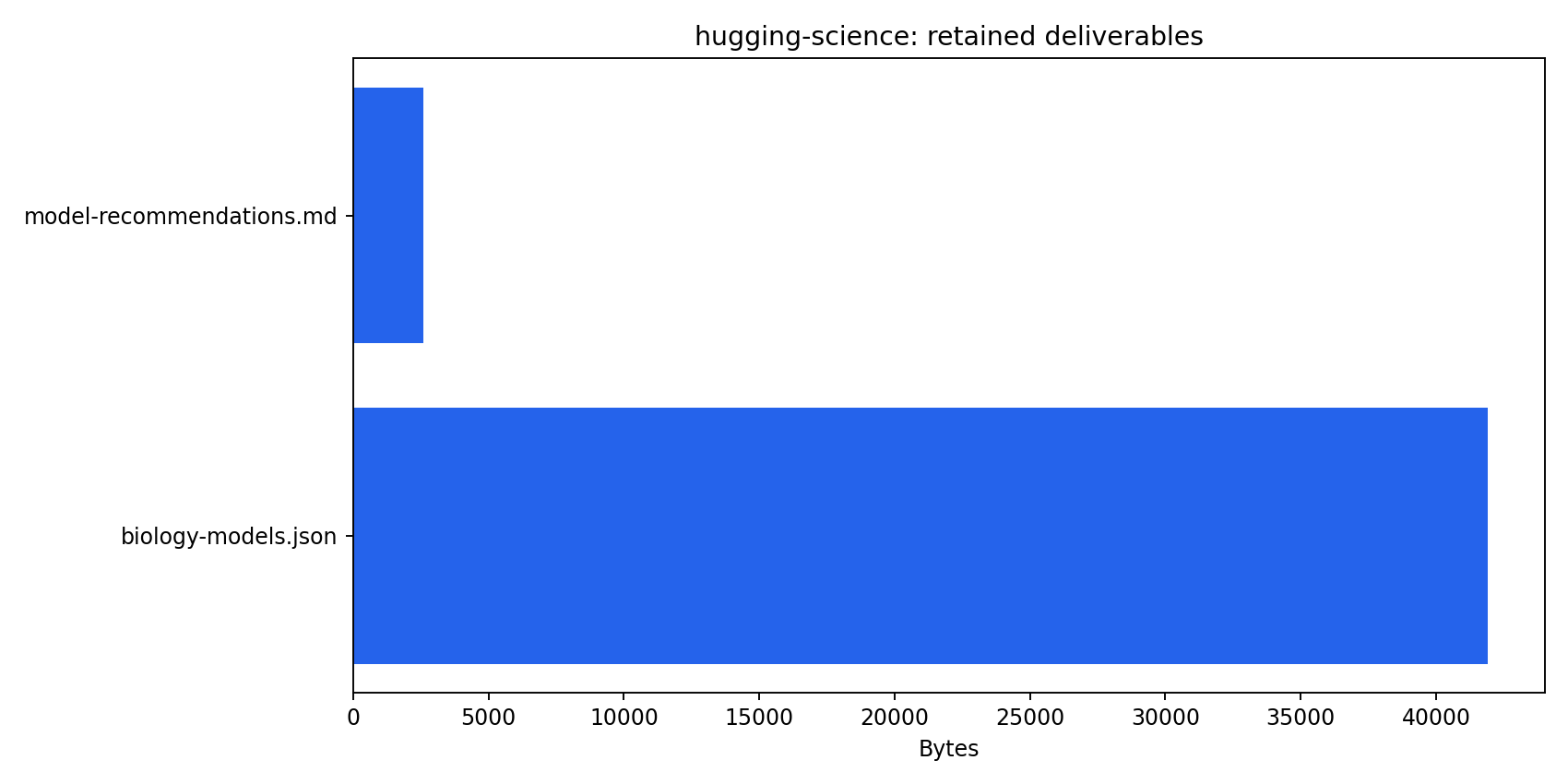
The inventory confirms that the expected deliverables were retained in distinct formats. File presence alone did not determine success; the semantic checks described above supplied the stronger gate.
Interpretation
The validated live catalog query found 95 biology-related model records. It produced a 41,912-byte JSON snapshot and a 2,587-byte Markdown recommendation report; it did not download, benchmark, or endorse any model. The result answers the bounded demo request. It should be used as a reproducibility example and starting point for expert review. Applying the method to new data requires restating the scientific question, checking applicability, choosing justified parameters, and rerunning all validation rather than copying this conclusion.
Failures, repairs, and alternatives
Earlier workflow development showed why fail-closed testing matters. A catalog-only check or empty command list can look green without exercising a feature, and an isolated chat environment may lack network access even when the host can retrieve public metadata. The repaired harness requires at least one scientific command, uses retained host preparation only when documented, and denies feature credit unless chat output passes a skill-specific validator.
Alternative installation methods should be documented only after they are exercised. A conda environment may isolate compiled dependencies; a Python virtual environment may be sufficient for pure Python packages; an official portable binary may avoid system mutation. Source compilation adds compiler and removal obligations. None of these alternatives changes the need to pin versions, verify downloads, retain logs, and test a real key feature.
Reproducibility
| Record | Value |
|---|---|
| Attempt | 3 |
| Host | Linux x86_64 |
| Accelerator | CPU or network/catalog path as stated; no undeclared CUDA credit |
| Implementation | Hugging Face Hub HTTP API |
| Method | catalog discovery and metadata filtering |
| Artifacts | biology-models.json and model-recommendations.md |
| Conversational execution | Completed and artifact-validated |
| Validation date | 2026-07-26 |
Reproduction should preserve input checksums, package metadata, command logs, structured results, screenshots, and semantic validation logs. Floating upstream catalogs can change, so a future query may return a different count without invalidating this retained observation. Physical or numerical workflows can vary with precision and platform, so tolerances must be scientifically justified rather than selected after seeing the answer.
Limitations
A catalog match is not evidence that a model is biologically valid, safe, reproducible, license-compatible, or suitable for a particular sequence, structure, cell, or clinical task. Model cards, training data, licenses, revisions, and executable code require separate review. The demonstration is intentionally small and cannot establish scalability, cross-platform equivalence, long-term service availability, or performance on private datasets. It also does not evaluate every feature described by the upstream project. The pass applies to the mapped key feature, declared environment, exact fixture, and attempt 3.
No uncertainty estimate should be inferred unless the method generated one. No accuracy, compliance, efficacy, safety, or ranking claim should be inferred merely from a successful technical run. Readers should preserve the distinction between observed output, model assumption, expert interpretation, and external validation.
Review questions before reuse
Before reusing this workflow, a reviewer should ask whether the new input represents the same type of entity, whether all identifiers and units have been normalized, whether the implementation and its defaults have changed, and whether the decision requires a stronger validation standard. The reviewer should also determine who is accountable for parameter choices, how anomalous or missing records will be handled, and which independent observation could falsify the computational conclusion. These questions are not administrative decoration: they define whether a technically reproducible run answers the intended scientific question.
The retained artifacts support an audit trail because they separate raw or structured output from the narrative report. A future operator can parse the files again, compare values against a new software release, or replace the interpretation without rerunning the original calculation. Screenshots are useful summaries for readers, but they should never become the only surviving evidence. Long-term records should include machine-readable data, human-readable explanation, provenance manifests, cryptographic hashes, and the validation status together.
Finally, responsible reporting should make negative information easy to find. An unavailable uncertainty, untested accelerator, synthetic fixture, incomplete corpus, or nonrepresentative toy system belongs beside the principal result rather than in an obscure footnote. This practice allows another scientist or an answer engine to quote the result without stripping away the conditions that make it honest.
Try this workflow
MindPlot has built-in support for this demonstrated scientific skill. Users can describe the task and data in ordinary language; the MindPlot agent writes and runs the required code, preserves deliverables, and reports qualified results, so users do not need to write the reproduction commands themselves. Try it at https://mindplot.ai, or download the desktop version for a better integrated experience and stronger local-data privacy.